Showing posts with label World War II. Show all posts

Saturday, January 08, 2022

Book Review The Vanished Collection

As I read The Vanished Collection by Pauline Baer de Perignon, I couldn't help comparing the differences between a book written for a French audience versus a book written for an American audience. In France, the subtleties count. In the U.S., we want the mystery laid out and the answer hinted at throughout so we can feel that sense of accomplishment at the end. 


At the beginning, the conflict was unclear. The author's cousin had hinted that perhaps her great grandfather's painting had been confiscated by the Nazis. Confiscated seems too tame a word. Stolen, taken, ripped from his grasp. But the family thought he had sold his collection. They thought her great grandfather and grandmother voluntarily moved from their Paris apartment. They didn't even think about the Jewish roots of their family and the dangers the ancestors faced living in occupied Paris. Slowly, the author reveals the research she did and how she discovered her great grandfather's life during World War II. 

Having researched the topic of stolen art during World War II for my novel The Summer of France, 


I was already enthralled by the idea of looking back at undiscovered thefts by the Nazis and the effort it takes to try to redeem the crimes committed in the 1940s. This book was set within the past five years. I enjoyed The Vanished Collection and the peek into the French mind, where no one wanted to discuss the atrocities of the Nazis during the war, preferring not to remember that neighbor turned against neighbor. But the author needed to knock on each door and dredge up each memory to search for the truth of her great grandfather's life. 

You can find this book on Amazon in kindle or paperback

Monday, April 27, 2020

Book Cover Reveal

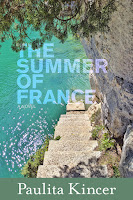
I'm excited to share with you a new book cover for The Summer of France, my very first published novel.
Without further fanfare:


Why, you may ask, a new book cover for The Summer of France?
Because The Summer of France is now book 1 in the series A New Life in Provence.
That's right, the 2nd book, Falling for Provence, is coming soon.
And I'll share that book cover when I have more details.
A shout out to my fabulous book designer Janna Thompson-Chordas.
When I was searching for someone to create covers, I thought about going with a designer far away in India or Pakistan, but then I thought to ask around my town in Ohio and found Janna. She designs covers for OSU publishing so you know she's a pro.
You, my readers, all have always been so supportive of my writing and I really appreciate it. I wonder if you'll be able to see differences in my writing now that I am living in France.
I'll tell you one change that I had to make as I was writing Falling for Provence. I had Fia, the main character, listening to Pandora music on her phone.
Guess what? You can't get Pandora in Europe. Good thing I moved here to learn that little tidbit.
If you are interested in learning more about when my next novel will be released, please leave your email in the comments or send me an email at paulita@paulitakincer.com and I'll begun compiling an email list.
That way, you won't miss it when book 2 of A New Life in Provence is released.

Friday, May 18, 2018

So We Always Remember

Anyone who knows me realizes that I avoid cruelty. I can't stand to watch it or read it. I just don't watch television shows or movies or even read books where people are cruel for no reason.
But that doesn't mean that I stick my head in the sand to avoid the world at large. Yes, I would rather only focus on the positive in the world, but I have to be aware of the news and things that go on to help avoid those same events from happening again.
That's why I agreed to visit Oradour-sur-Glane in the Limousin region of France.
Earl has written a blog post in more depth about the history and I'll direct you there for that, but I wanted to share with you some of my experience.
Our friends Norman and Caroline shared with us a booklet about the town so we could be prepared.
During World War II, on June 10, 1944, German SS soldiers appeared one day out of the blue and killed every person they could find. They shot the men before setting on fire the buildings where they'd shot them. And they locked all of the women and children into the church before setting off an explosion and then burning it.
642 people massacred. Only one woman escaped the church alive by jumping from a 9-foot window. The Germans shot her as she made a break for it, but she lived, hidden among the rows of peas growing in the garden.
It is too horrible to imagine.
And the people of the village, those who somehow lived, or those who were gone to work that day, never rebuilt the village. They built another village nearby so the burnt out village where so many died stands today as a testament to the atrocity of the Nazis.
As we drove toward the village, about an hour and a half from our housesit in Chateaneuf-sur-Charente, I noticed that I was yawning, big yawns. I'd slept okay the night before, so felt like my body was just reacting to the scene I would soon face.
Parking is free and we entered the memorial building, which is underground. It crosses below a road and then visitor climb up to see the destroyed village. Anyone entering or exiting must go through the memorial.
View as we walked toward the memorial

This placard reminds us to "Remember" what happened here. 

The Nazis burnt the whole town in hopes of hiding their atrocity.
No one knows for sure why killed everyone in the village. Some say there was another village called Oradour where some resistance fighters were working. Apparently, this occupied village had never had trouble with the Nazis there. They all appeared when they were called to the square, except one eight-year-old boy who had lived in Lorraine, France and knew what the Germans were capable of, so he ran and hid in the garden of the school rather than walking to the village square. He survived. The only child in the village left alive at the end of the massacre.

The flames in the church were so hot that they melted the bell which crashed to the floor below. 
The church, where the women and children died, was of course a central point for visitors. Even though the roof is gone and it stands open to the air, the charred smell remains. A memorial to World War I soldiers is built into one wall, the residents never imagining that their village would sacrifice even more in the second World War than they did in the first, right there beneath the plaque.
Earl pointed out the number of sewing machines in the burnt-out houses. What a normal household
 item to see in so many French homes from that time, never to be used again. 

The men were taken to different buildings and shot. Each building where men were shot had a placard.
This one also has a notice that six men escaped. 
Apparently, the men who escaped, fell to the ground feigning that they had been shot and did not move as the Germans continued to shoot anyone who moved or moaned. Then when the place was set fire, they hid and about a dozen or more men managed to survive the massacre.
Like visiting a concentration camp, it takes your breath away to see the signs of such hideous cruelty.
We must be aware of it so we can say never again.
Wildflowers grow here, in the midst of the destruction.
And it doesn't have to be big cruelty, it can start with something as simple as pulling a toddler out of his mother's arms when they arrive at our borders. Separating them as a warning to people not to seek help from the United States, a country that was built on immigrants.
"Immigrants, we get the job done!" from Hamilton  in a line by Alexander Hamilton (an immigrant) and Marquis de Lafayette (also an immigrant at the time).
We can't allow even these easily overlooked cruelties to snowball to the point where it is not a big deal to lock the doors of a church and set it on fire, shooting machine guns at anyone who tries to escape as women and children burn to death.

Sunday, November 06, 2016

Dreaming of France -- St. James Cemetery in Brittany

Thank you for joining this weekly meme. Grab a copy of the photo above and link back to An Accidental Blog. Share with the rest of us your passion for France. Did you read a good book set in France? See a movie? Take a photo in France? Have an adventure? Eat a fabulous meal or even just a pastry? Or if you're in France now, go ahead and lord it over the rest of us. We can take it.

This week we commemorate Veteran's Day, so I thought I'd share some photos that Grace and Earl took when they traveled to St. James Cemetery in Brittany. Here's a link to more information about the cemetery called Brittany American Cemetery. 


Earl pointed out all of the ethnic names of the soldiers who died fighting for freedom -- for the U.S. and Europe.


I love the sky in this photo.

And the crosses. So many people fought for freedom. 
Thanks for playing along with Dreaming of France. Please leave your name and blog address in Mr. Linky below, and leave a comment letting me know what  you think about my love affair with France, or your own passion for the country and its people and cultures. Also consider visiting the blogs of others who play along so we can all share the love.

Friday, June 06, 2014

World War II Uncles

Today, the news is full of the 70th anniversary of D-Day and rich descriptions of beaches that are overlooked by bluffs covered with white crosses.  It's hard for us to imagine that kind of loss of life, but there are many men headed to France who lived through that day. I, of course, am fascinated by all things French, so I love hearing the stories from the anniversary commemoration.
Two of my uncles fought in World War II, but neither of them were at Normandy 70 years ago.
It seems just a few years ago that I sat on an uncomfortable picnic table videotaping my four uncles (on my mom's side) as they described their military service.
Uncle Junior (that's what we always called him, but his name is Luther) was drafted into the army. He was sent to Italy and was wounded three times. Each time, they sent him back into battle.
Here's a picture of my mom with Uncle Junior last year. 
I'm not a history buff, but as Uncle Junior mentioned each battle he was a part of, Earl's eyes would grow wide. He was wounded at one battle, the Battle of Anzio, but recovered enough to be sent to an even worse battle.
"Out of the frying pan, into the fire," he said.
I'll have to revisit those tapes so I can remember more specifically where Uncle Junior fought.
His stories were part of my inspiration to write the character Uncle Martin in my novel The Summer of France. The only thing they really shared though was fighting in Italy and growing up in Kentucky.
My real uncle came home after the war and married a wonderful American woman.
When Uncle Junior got in the war, he wrote home and warned his brothers to enlist rather than get drafted into the army. So Uncle Clarence, the next oldest brother, joined the Navy. As we talked about war experiences that day, he went to the car and pulled out an envelope that had a large laminated certificate that declared he had crossed the international dateline.
Uncle Clarence died a year and a half ago, but Uncle Junior was at the family reunion again this past Sunday. He's thin but cheerful and always loving.
I'm so thrilled that I've gotten to hear my uncle's stories and share in their lives. They gave a lot for the safety of our world and hopefully, they felt they lived the kind of life they wanted in repayment for their service.

Thursday, March 20, 2014

My Novel For a Bargain Price

Thursday through Saturday, my first novel, The Summer of France, is available for only 99 cents on Kindle.
If you haven't read it yet, I hope you'll buy it.
If you have, why haven't  you written a review for it on Amazon? Well, a lot of you have, so thank you.
Here's a description to tempt you:
Could a crackly phone call from France to Ohio save Fia Randolph’s jobless complications and family troubles? That’s what she hopes when her Uncle Martin asks Fia, her husband, and teenage twins to move to Provence and take over his bed and breakfast. She envisions long picturesque walks carrying crusty baguettes and bonding with the kids as they all learn French. But Fia didn’t bargain on the way Provence would tempt her teens and husband away from the family. Then Uncle Martin’s World War II secret wrenches her family further apart. Can Fia pull her family back together and help clear her uncle’s guilty conscience?
Thanks for your support. Hope you enjoy it.

Friday, November 15, 2013

France Book Tours Wolfsangel & Saturday Snapshot

At the beginning of this book, set in eastern France, we learn that the main character has a secret. It is clear that 68 years after World War II, she still feels guilt over something. 
 As I read Wolfsangel by Liza Perrat, I tried to guess what might have happened. So many awful things happened in World War II. Was she a conspirator? Did she betray someone accidentally because she fell for a handsome German officer?
Wolfsangel focuses on Céleste Roussel, a woman of around 20, as her French village is overrun by German soldiers. Céleste finds herself attracted to a German officer even as she continues perpetual arguments with her mother who has always disapproved of her.
This isn't simply a war story; it's the story of people who can't believe the meanness going on around them. They fight to save those they love. The characters in this novel are passionate and even though I know the overall conclusion of the war, I found myself wondering what would happen at each mission. The story was interesting and quick moving. In addition to Céleste, her brother Patrick, and childhood friends Olivier, Miette, and Ghislaine, join the resistance to defeat the Nazis.
What I didn't like about this novel -- the title or the cover. Neither of them would have pulled me in if I hadn't been asked to review the book. Although the title Wolfsangel is explained as a symbol of the SS German police, and Céleste's older sister is described as an angel, the title didn't resonate with me. The book cover isn't clear to me. The character looks more like a chimney sweep than a resistance fighter and I was never clear about the bird and I couldn't really tell that the building among the smoke was a church.
For me, the book was a pleasant surprise. It had some violence, obviously, since it was set in war time, but it all worked to set an authentic scene.

Here's the synopsis:
Seven decades after German troops march into her village, Céleste Roussel is still unable to assuage her guilt.
1943. German soldiers occupy provincial Lucie-sur-Vionne, and as the villagers pursue treacherous schemes to deceive and swindle the enemy, Céleste embarks on her own perilous mission as her passion for a Reich officer flourishes.
When her loved ones are deported to concentration camps, Céleste is drawn into the vortex of this monumental conflict, and the adventure and danger of French Resistance collaboration.
As she confronts the harrowing truths of the Second World War’s darkest years, Céleste is forced to choose: pursue her love for the German officer, or answer General de Gaulle’s call to fight for her country.
Her fate suspended on the fraying thread of her will, Celeste gains strength from the angel talisman bequeathed to her through her lineage of healer kinswomen.
The decision she makes will shadow the remainder of her days.
A woman’s unforgettable journey to help liberate Occupied France, Wolfsangel is a stirring portrayal of the courage and resilience of the human mind, body and spirit.
Leave a comment to be registered to win a copy of this book. I'll draw a winner on Saturday, Nov. 23.

 Also this week is Saturday Snapshot.
To participate in the Saturday Snapshot meme, post a photo that you (or a friend of family member) have taken. Then leave a direct link to your post on West Metro Mommy. Photos can be old or new, and be of any subject as long as they are clean and appropriate for all eyes to see. How much detail you give in the caption is entirely up to you. Please don't post random photos that you find online.
This is a touristy, kitschy place here in central Ohio. It probably was a corn field originally. Now it's a field full of corn statues. I took it as a panoramic shot, but it doesn't seem to be expanding when you click on it. You'll have to take my word for it that the entire field is full of concrete ears of corn over six feet tall.

Thursday, November 14, 2013

FranceBookTours -- WolfsAngel Excerpt & Giveaway

For France Book Tours, I'm reviewing the historical fiction novel Wolfsangel by Liza Perrat set in France during World War II.
I don't want to give anything away, but the tension is high as the resistance fights again the German occupiers and the main character flirts with a German officer in hopes of gaining information.
Check back on Saturday for a full review.
For today, please enjoy this excerpt from Wolfsangel and leave a comment to be registered to win --two ebook giveaways in the U.S. and one signed paperback in Europe.
 We gather in the cemetery, before the ossuary, with
the straggle of other remaining survivors and their
families. Our heads dipped, the mayor begins his
memorial speech to commemorate the tragedy that became a
legend around these parts; the evil that part of me still believes
was the result of my own reckless actions.
There isn’t a region in France that didn’t pay the price of war
with the blood of its children, but here in the village of Luciesur-
Vionne one can truly contemplate the depths to which the
pure devilry of man was cast.
The chill of last winter stole my husband, and though my
extended family are with me, I feel lonely without him by my
side, remembering the fateful afternoon that has tormented me
for sixty-eight years — the sickening odour of charred flesh, the
smoke parching my throat, the green-brown blur of the woods
as I fled the clomp of German boots. My fingertips skitter across
the scar on my left arm, eternal reminder of that inconceivable
climb, then the free-fall of an unstrung puppet, and the certainty
that I too would die any second.
My conscience might have been soothed if I’d been punished;
if I’d had to pay somehow, but by then there was barely a soul left
to sit in judgement.
Perhaps that’s why I chose to become a midwife, bringing
new lives into a world from which I’d taken so many. Or, as my
mother claimed, the birthing skills were simply in my blood.
I glance across at my granddaughter, who wears the bone
angel necklace these days. She’s gripping the pendant between
her thumb and forefinger as I used to; as countless kinswomen
of L’Auberge des Anges did before us. I touch the spot where it
once lay against my own breast, feeling its warmth as if I were
still wearing the little sculpture.
I wonder again if my daughter and granddaughter truly
understand what that heirloom endured with me through those
years of the occupation. Can they grasp the comfort, the strength
it gave me? I doubt it. You’d have to live through a thing like that
to really know how it was.
My eyes slide down the list of names engraved on the ossuary’s
marble plaque, their cries, curses and laughter chiming in my
ears as if it were yesterday.
The breeze catches the perfume of lilacs and splays the
velvety heads of the red roses, like opened hearts, as the mayor
concludes his sombre speech. We stand in silence for a minute,
remembering those who never got the chance to grow old —
loved ones who perished for our freedom.
From beside the row of the oldest, grandest headstones, the
band strikes up La Marseillaise, the trumpets drowning out
shrill birdsong and the low hum of a passing tractor.
We trudge out of the cemetery and head along the woodland
path to the Vionne River for a picnic lunch, as we do every year.
It’s part of the ritual.
Ip, ip trills a bird. Ga, ga cackles another. A dragonfly hovers
over a seam of current that folds the waters of the river across
stones, ferns and errant flower heads. The Vionne displays her
illusion of tranquillity, though I know, better than most, that it
has claimed victims — witches of the Dark Ages punished by
drowning, and the children who perished two centuries ago, for
whom a stone memorial cross sits on the ridge.
I think of the others who died here — those who have no
such memorial; not the slightest trace, for rain and snow have
long since washed away the bloodstains. I have always wondered
who found them and where they were buried, and if it weren’t
for a dog-eared sepia photograph gathering dust in a secreted
wooden box, I might convince myself they had never existed.
After the picnic, my daughter offers to drive me home to the
farm. No, thank you very much, I tell her, I’m only eighty-nine,
still quite capable of walking back to L’Auberge.
L’Auberge des Anges, haven for weary travellers, orphans and
refugees, which has withstood centuries of plague, revolution
and war, reclines on the crest of the slope like a solid matriarch.
I shuffle through the wooden gateway, the sun flinging its
warmth across the cobbled courtyard, the pink puffs of cherry
blossom and the white backsides of rabbits bobbing through the
orchard.
My daughter fancies herself as an artist and as I negotiate
the uneven cobbles, I dodge the collection of sculptures she
has fashioned from scrap metal, waste and discarded objects —
effigies of our loved ones who never came home. The official
document confirming their deaths didn’t arrive until 1948 but it
seemed we’d already mourned them for a lifetime.
Curious travellers who have heard of the tragedy stop off in
Lucie-sur-Vionne on their way south, or west to the Atlantic
coast, for summer holidays. Once they’ve toured the legendary
site they find their way up here to L’Auberge des Anges, and
wander amongst my daughter’s sculptures. They ask us who the
people were, and they want to know about Max, as they admire
his paintings in the gallery.
I climb the steps, wincing as another barb pierces my frail
shell. It appears from nowhere, this guilt I claimed from the
smouldering wake of that evil reprisal. I know it will shadow
me for days, weeks or months. Then, as winter seems to have
settled forever, spring arrives, and my self-reproach will vanish
for a time, only to return to the same dark nooks of my mind,
the cycle beginning again.
No one ever knew for certain why they marched into Lucie
sur-Vionne that hot June morning of 1944, but it is a crime I
have never been able to forget. Nor can I forgive. Least of all
myself.
I'll see you again on Saturday with my review. And leave a comment either today or Saturday or both to be entered to win a copy.

Tuesday, September 10, 2013

World War II Saga Plus Giveaway

I love to hear from authors who want me to read their books. I suppose someday I might get tired of it, but not when I receive a book like The Gods of Heavenly Punishment by Jennifer Cody Epstein.
Truthfully, from the title and the description, it's not a book I might have picked up, but I'm so glad I did.
From the very beginning, the writing is beautiful. Ahh, so this is a well-written literary novel, I thought. Not one that tries to impress people with its words, but one that lets the story slowly unfurl as the reader connects to each character.
The author is obviously someone who loves Japan as much as I love France. The details about Japanese homes, culture, and customs are definitely intriguing.
The novel begins, both in New York and Tokyo in 1935, introducing us to characters who are not yet affected by the coming war. The saga continues through the midst of the war, focusing on attempted attacks and the devastation in Japan. Most of us probably know the results of the atomic bombs dropped in Hiroshima and Nagasaki, but I was unaware that Tokyo was firebombed and largely destroyed along with thousands of residents killed.
But that isn't what this book is about either. It's about the people and how they survive and whether love can grow in spite of evil deeds.
I can't possibly explain why I loved this book, so let me share a couple of passages. Anton, an architect who lived in Japan for more than a decade was asked to help the U.S. government figure out how to best bomb Tokyo. He built a Japanese village using authentic materials. When he couldn't get the floor mats the Japanese used, the U.S. government supplied them from an unknown source.
Anton had tried not to think about the mats'"lenders" as he inspected each of the units individually. Like the ghosts of his flaming oboji, though, they came to him anyway, their former lives whispered from the scars and nicks etched into the rough weave: dents from a low table, laden with food or books. Nail varnish from a careless pedicure. A sickle-moon scuff mark, the approximate shape of a toddler's sandaled heel. They haunted him, these small marks left by lives upended. But as Anton repeatedly reminded himself, he had taken the job. He had to agree to the rules.  

What details. What a way to delve into this character's ghosts as he helped fight war against a people and architecture he loved.
 Here's a passage from a lunch betweem Anton and Hana, another main character who is a glamorous Japanese woman raised in Great Britain.
"I can't eat when I'm nervous."
"Nervous?"
She exhaled a lazy plume of smoke, studying him as though trying to decide something. Finally, she said: "Certain people -- certain men -- have that effect on me."
At first Anton wasn't sure he'd heard correctly: she'd said it in the same way she might casually bring up a food allergy. When he did register her meaning there was a moment of disorientation. She's not well, he thought, as he had two weeks earlier. It occurred to him that it might be a good time to reemphasize the fact of his marriage.

In spite of loving the writing in this book, something happened, a plot twist in the third chapter, that almost made me put it down. Even now that I'm finished, I see so many possible ways the plot could have been changed so that readers wouldn't have that jarring, book dropping occasion. And that occurrence does taint my view of the novel. I'm very intolerant of violence and cruelty. Still, the rest of the war atrocities throughout the book didn't affect me as deeply as this one event, which I'm not revealing because it would be a spoiler.

I would probably give this book 4.5 out of 5 stars. I hope you'll give it a try.

a Rafflecopter giveaway

Interview with Jennifer Cody Epstein

Visiting today is author Jennifer Cody Epstein, who wrote The Gods of Heavenly Punishment, a truly lovely novel. You can see my review of her novel here. Hope you enjoy her insights.
Jennifer Cody Epstein
Here's a picture of the author that I stole from her website.
Hope she doesn't mind.
Q. How would you sum up The Gods of Heavenly Punishment for those who haven’t read it yet?
 Tough to do in a few words, as I've been learning! But essentially, it's an exploration of a key (but often overlooked) moment of the Pacific War: the firebombing of Tokyo, which killed 100,000 civilians in a few hours. I approach the subject from both sides of the conflict as well as from both the years leading up to it and those in its wake. It's also a meditation on war in general--what we lose, but also what we gain in the aftermath of enormous tragedy. 

Q. What idea or event inspired you to write your novel? 
 I've always been fascinated by Japan, and by America's evolving relationship with it. I lived there for five years, and while I'd heard much from my grandmother about how hated and feared the Japanese were during the war (like most in her generation she was pretty thoroughly propagandized, I think, and was alternately fascinated and slightly shocked by my decision to study there as a student) I could never comprehend how our two nations had descended to such levels of deep, mutual hatred--and then emerged from the war's wake as such strong allies. Then my husband came across a mention of the firebombing in an interview he was conducting (he's a filmmaker and has been making a documentary about a war crime in Iraq), and he came back and asked me what I knew about it...which, I realized abruptly, was pretty much nothing. So I looked it up online--and was flabbergasted that an event of such enormous human cost and complex ethics seems to have been left out of the story of World War II for most of us. I wanted to fill in that gap for myself--and (hopefully) for readers. 

Q. As an author, how much research is required for a book like this? Do you research from home or does it include travel?
I researched a lot--which for me isn't as onerous as it might sound because I actually find researching much easier than writing (!) Most of it was through books (both fiction and nonfiction) written reports, online documents and images etc--but I also travelled back to Japan in  2009 and interviewed three extraordinary women who had lived through the firebombing and very much wanted their stories about it to be passed along to the next generation. 

Q. Which character do you relate most to in The Gods of Heavenly Punishment? Do you share traits with any of the characters?
 I think I'm a combination between Yoshi and her mother Hana. I share Yoshi's fascination with language and her sort of introverted, meditative view of the world--but also I relate to her mother's fear of rejection and her perpetual sense of not fitting in--as well as her alternating tendencies to both embrace her (perceived) eccentricities and suffer because of them.  

Q. Please share your writing story. How did you begin and what helped you succeed?
 I've always loved to write, and I've always loved books. When I was very small one of my favorite pastimes was to staple together sheaths of paper to make "noves" that I'd then fill with pictures and stories, and as I got older I was almost always deep into a real novel no matter what I was supposed to be doing (I used to hide them on my lap when I was theoretically doing my homework, and prop them on the piano when I was supposed to be practicing!). I think in part it's that passion that helped me finally become a "real" writer--it was pretty much all I ever really wanted to do. That said, I also think that community was essential for my development as a writer. Working on my own, I started dozens of projects but really only ever finished a few short stories between the ages of 18 and 28. It was only when I went to graduate school, and found myself surrounded by fellow writers who would not only motivate me to keep going but would challenge me to do it better that I wrote anything worth finishing--not to mention worth publishing! That experience taught me how crucial feedback and support is to the writing process--and as a result, I've continued to work with writing groups since graduating. 

Q. What authors or books influenced you? 
 So many! But I'd say for this book in particular Sarah Waters' The Night Watch and Ian McEwan's Atonement were particularly important--both for the way they handled war's devastation and the skill with which they intertwine very different perspectives into a single narrative. 

Q. Are you working on a new project now that we can look forward to?
 I have started several and am only now deciding which one to go ahead on--but I think it will be another look at World War II, this time from the European angle. But it will also be an exploration of female friendship--how it shapes us, and also how it can both fail and redeem us. I'll keep you posted! 

Hmm, I wonder if Jennifer has read my novel with its take on a moment in World War II. Maybe, like me, she realizes how quickly people who remember those wars are fading from our lives.

Thanks to Jennifer for your interview and for sharing  your novel. 

Sunday, May 26, 2013

Dreaming of France -- Memorial Day Commemoration


Please join this weekly meme. Grab a copy of the photo above and link back to An Accidental Blog. Share with the rest of us your passion for France. Did you read a good book set in France? See a movie? Take a photo in France? Have an adventure? Eat a fabulous meal or even just a pastry? Or if you're in France now, go ahead and lord it over the rest of us. We can take it.
Maybe we can all satisfy our yearnings for France, until we get there again.
Since we're celebrating Memorial Day here in the United States, I'm posting a couple of pictures from Normandy Beaches that Tucker took during his trip in April. The first one is a panoramic view so if you click on it you should get the full impact.
 They visited a cemetery and memorials to the servicemen who died there.
 This cemetery full of crosses is so sad. I just imagine all of the youth and vigor of the men who poured out onto those beaches, so many of them never saw their sacrifice pay off.
 
But our life today, our Memorial Day Sales, and picnics and bicycle rides are all thanks to what they and their families gave up.
My novel The Summer of France includes one of those American World War II soldiers who never returned because he fell in love with a French woman. Summer is a perfect time to pick it up if you haven't yet. It's in paperback for $14 or on Kindle for $3.99.


Wednesday, April 10, 2013

I Got a Rock

Sending Tucker off to France last week, we all had high hopes for gifts that he would bring back.
He brought me some yummy dark chocolate. Grace got a soft, orange scarf.
Earl got a rock.
"I know this seems lame," he said as he handed Earl the smooth, brown stone, but it came from Omaha Beach.
He showed us a picture he had taken on the beach with the rock in his hand.
Tucker knows that his dad is a history buff and has always wanted to visit the Normandy beaches where the Allies launched an offensive against German-occupied France in World War II. Omaha Beach is one of those beaches. He also took pictures of the inside of the pillboxes, defensive structures the Germans had built to fight against the invasion. The roofs of the pillboxes were scorched from the fighting.
In an attempt to redeem himself for the rock, Tucker also gave us a bottle of wine. He had pictures from the cave that they toured and where he purchased a 10 Euro bottle of wine. He didn't say if he tasted several in an attempt to find the right wine.
We were a little surprised that he was allowed to bring it in to the U.S. since he's under 21, but we didn't question it.
We enjoyed some wine on the front porch last night and it was delicious.

Sunday, January 06, 2013

Remembrances

My Aunt Marie, dressed in blue, her hair a faded honey color that reached nearly to her shoulders, stood watching her 12 adult grandchildren get their photograph taken.
"Do you want to get in there and have your picture taken with them?" I asked her.
"I guess," she said and took a few steps toward them. Then she stopped.
"No," she blinked away tears. "It's too sad without Dad."
We were at the dinner following her husband's funeral.
My Uncle Clarence died New Year's morning in his sleep. He hadn't been sick. His oldest son thinks he knew he was getting ready to go: "He always said he wanted to go on the back of a tractor and he ran that thing pretty hard the last forty-eight hours."
One of my other aunts asked Marie how old she was when they married 66 years before.
"I was one month shy of my 17th birthday," she said.
In Kentucky, where they lived, she had to be 17 or get her parents' permission to marry.
"My parents wouldn't sign," she said. "They liked Clarence just fine but thought I was too young to know what I was doing."
So her cousin forged the signature, and Clarence married Marie, and they were together for 66 years until Tuesday morning when she found him still in bed at 8 a.m. He had watched the celebration of the New Year before dying in his sleep.
During the funeral, I was sitting behind my Uncle Jim. Uncle Jim has one daughter and one granddaughter. So when the preacher read the list of survivors for Uncle Clarence -- four children, 16 grandchildren, 29 great-grandchildren and three great-great grandchildren -- Uncle Jim exclaimed, "Lawd Al-mighty!"
Uncle Clarence was in the Navy during World War II, so soldiers stood by the gravesite and gave a 21-gun salute. A sailor was there to play "Taps."
When I wrote my novel The Summer of France, I based one of the characters on my uncles' war stories. The character Uncle Martin was a Kentucky boy who jumped in to join the war effort. I even dedicated the book to my uncles.

My Mother in the center. Uncle Albert is on the far right with Uncle Junior next to him.

But I never gave Uncle Clarence a copy before he died. I took copies yesterday for Uncle Junior, 91, and Uncle Albert, 80,  who are still healthy. I wanted to make sure they knew they had inspired me. And I gave a copy to one of Clarence's daughters. So many of us have older relatives that we take for granted. Don't wait until it's too late to gather their stories.
You never know when  you may need a story to draw on, and all of that wisdom is just waiting to be shared.  

Saturday, October 06, 2012

Saturday Snapshot -- My Nose in a Book

To participate in the Saturday Snapshot meme post a photo that you (or a friend or family member) have taken then leave a direct link to your post on Alyce's blog At Home With Books. Photos can be old or new, and be of any subject as long as they are clean and appropriate for all eyes to see. How much detail you give in the caption is entirely up to you. Please don’t post random photos that you find online.
 
This week, I'm combining two old things: following  up on the picture from last week where I broke my nose 24 years ago and again last week, I had to have surgery to straighten it yesterday. The doctor convinced me it would be quick to fix while the bones were still broken.
So broken nose, plus -- my book published.
 
Yes, I'm hoping for some sympathy purchases... But it's also a fun book. Hope you'll give it a try.
Here's the premise:
 When Fia loses her job, she jumps at the chance to travel to France to run her great uncle's bed and breakfast, dragging along her husband and teenage twins. She figures the whole family can bond before the twins grow up too fast. But her dreams of family bonding time fade as Kasie joins a local swim team, riding off to practice on the back of a scooter each morning, hips tucked next to the 18-year-old French boy who teaches her to smoke brown cigarettes and drink red wine. West accompanies a pouty French teenager around the city, playing his guitar in the town squares to earn spending money.  And Fia's husband Grayson tours the countryside with a pretty French woman. Why the whirlwind of French welcome, Fia wonders after she comes hom froma day at the beach in Nice with the handsome Frenchman Christophe, only to find someone has ransacked the B&B.
Fia doesn't know that the house hides her uncle's World War II secret, which might just tear her family apart.
So, are you intrigued?
You can find the book on  Amazon for the Kindle, on Barnes and Noble for the Nook or in paperback. The eBook versions are $4.99 each. And if you don't have an eBook reader, you can download the Kindle reader for free on Amazon and read it on your computer. But if you prefer to have the book in your hand, the paperback is $14.
I can't wait to hear what you all think about it.


Thursday, October 04, 2012

My Book is Now Available

That sounds kind of low-key, doesn't it?
Oh, anyone interested in buying my book?
Maybe if I used all caps: MY NOVEL, THE SUMMER OF FRANCE, CAN NOW BE PURCHASED.
I am so excited.
Here's me when the first copy came in the mail:
 
The Fed Ex guy didn't even get to the door. I met him on the front porch.
Lots of you know that I've been working on this novel, revising, refining. But for anyone who doesn't, here's the blurb:
 
Could a crackly phone call from France to Ohio save Fia Randolph’s jobless complications and family troubles? That’s what she hopes when her Uncle Martin asks Fia, her husband, and teenage twins to move to Provence and take over his bed and breakfast. She envisions long picturesque walks carrying crusty baguettes and bonding with the kids as they all learn French. But Fia didn’t bargain on the way Provence would tempt her teens and husband away from the family. Then Uncle Martin’s World War II secret wrenches her family further apart. Can Fia pull her family back together and help clear her uncle’s guilty conscience?
And where can you snatch up a copy of my book?
The paperback will be available on Amazon, but it isn't there yet. Right now, you can find it here. And if you type in the Code PLUMA by Oct. 5, you can get a 20 percent discount.
 
You can find it in ebook form for only $4.99 on Amazon for the Kindle here and on Barnes and Noble for the Nook here.
I'm so happy about my novel, that I can almost forget about my impending nose surgery tomorrow. But I'll fill you in on that later. Let me bask in the glory for a few more hours.


Tuesday, October 11, 2011

First Paragraph, Teaser Tuesday -- 13 rue Therese


Every Tuesday, Diane at Bibliophile by the Sea posts the first paragraph of her current read. Anyone can join in. Go to Diane's website for the image and share the first paragraph of the current book you are reading.
Continuing my obsession with all things French, I have the book 13 rue Therese by Elena Mauli Shapiro. I picked this book up at the beginning of summer, thinking Grace might want to read it before she headed off to France, but she didn't. Last night I picked it up and thought it looked intriguing. An American professor arrives in Paris and finds a box of artifacts that tell the life of a woman who lived through both World Wars. He becomes consumed with the story and the gaps between. Here's the first paragraph:
Josianne's gift is a simple square box, its sides about as long as her forearm. It is about as deep as her hand is wide. The white plastic lid has a quaint red crosshatch pattern on it, like the sort you might see on a tablecloth in a small family-owned restaurant. The box is nothing extraordinary, though its contents have been known to induce fevers. At least, that is one of the effects it had on Josianne when it first came to her -- perhaps she decided to pass on her gift as much from a need to get it away from herself as to share it with another. At least, the box let her think she decided.

What do you think? Would you keep reading? Just in case you haven't decided, take a look at this Tuesday Teaser.


Teaser Tuesdays is a weekly bookish meme, hosted by MizB of Should Be Reading. Anyone can play along! Just do the following:

Grab your current read
Open to a random page
Share two (2) “teaser” sentences from somewhere on that page
BE CAREFUL NOT TO INCLUDE SPOILERS! (make sure that what you share doesn’t give too much away! You don’t want to ruin the book for others!)
Share the title & author, too, so that other TT participants can add the book to their TBR Lists if they like your teasers!
Here's my teaser from a random page:
She wants to laugh at this, but at the same time, she wants to curl up, wrapped in sadness. The fire of this overwrought feeling -- this constant feeling of the animal self caged and unable to run free -- she thought that this feeling would wane after the end of the war, after the first flame of her youth faded. It is not so.
~p. 128, 13 rue Therese by Elena Mauli Shapiro
To keep reading or not, that is the question?

Wednesday, September 29, 2010

Stories from an Old Man

On the flight to Charlotte, I sat next to a talker. He was a wiry old man with a fringe of white hair around the back of his head and some long white hairs sticking out of his neck.
His stories included becoming a homeless orphan on the streets of London during World War II, graduating from Cambridge, a practical joke on the Queen of England, writing jokes for the Benny Hill show, adopting four orphans, one of whom was killed at the Pentagon on 9/11, holding off 20,000 Vietnamese soldiers for a week with ex-lax in their rice. This guy is either a pathological liar or he has really accomplished a lot in his life.
He began by telling me he was the Chief Technical Officer of a company and was flying to Charlotte for some medical treatment. He gave me his business card to show that his business is all about alternative energy. He explained that the profits from the company go to make prosthetic limbs for people in African countries who have been tortured and mutilated. This is all very admirable and I'm beginning to be impressed.
"And if we find the torturers, we annihilate them," he said.
I look away at that point...cause what can that mean for this skinny old man whose hands shake?
"Well, if someone doesn't take care of them, they'll spread, like the Nazis," but he pronounced it Naazis with a nasal A sound like someone from Minnesota rather than England.
It was a little difficult to hear all of his stories on the small noisy planes, but he claimed he holds the patent on the "after burner" that runs jets and that he was test pilot on the Concorde.
All of this success, made me wonder why he was scrunched into a seat on a Continental flight rather than flying in his own plane. Oh, he had his own plane that he designed and built but it was in Texas. He only takes enough money from his business to live on and the rest goes to charity, he said.
"For the benefit of the environment and future generations" reads the line on his business cards.
He claims when he was orphaned in World War II he would take the clothes off dead bodies to keep warm.
He also says he has written a book that makes calculus and algebra unnecessary. He can do calculations on his fingers faster than and calculator or computer. One of his jobs while in college was to collect rats for scientific experiments and one night as he was climbing out of a coal bin with a sack full of rats, the police arrested him thinking he was a burglar. He wouldn't show them what was in the sack until they called the police to come to the station. That's when he emptied the sack on the floor and two dozen rats scattered throughout the police station.
"You can read all about these things. It's right in those papers," he pointed toward the overhead bin.
"Oh, you've written a memoir?" I asked him.
"No, but Hollywood wants to make a movie of my life," he said. "They're just waiting for some things to be declassified."
I think that's true for most of us.

The Olympic Cauldron

 Many people visit Paris in August, but mostly they run into other tourists. This year, there seem to be fewer tourists throughout the city ...